Henry: Alright Linus, how’s it going? Before we get into anything else, how did you first get into footwear, and when did Nike come into that?
Linus : I think it was a mixture of things for me, really. It's not something that has run in my family in any way. No one in my family was into the same sort of thing growing up.
I think like being at the skatepark as a kid a lot in Bristol, there were always kids wearing, I don't know, like Nike 6.0s on their BMXs and like old SBS and stuff. But they always seemed quite expensive, so I just never really got them. I was always just wearing Vans. But then there was this streetwear shop in Bristol called Five Points - that is sadly not there anymore - But yeah, I went into town with my mum, God, I must have been like 14, and I got my first pair of Nikes.
I've still got them now. It's a pair of Nike Huarache. So I started wearing them, but I still wouldn't say it really started there. Although that was my first pair, I wasn't like collecting, and I wasn't really interested in it at all - I just wanted a pair of Nikes.
And then I guess growing up on Facebook there were pages like Wavy Garms, and in the late 2010s, everything was shifting. Streetwear was coming up to the surface, and at that same time, me and my pals were buying lots of stuff online to sell on these Facebook pages, and going to charity shops.
Henry: So purely buying stuff to flip it, really? And then keeping the best bits for yourselves?
Linus: Yeah, a hundred percent. And whether that be like old Ralph Lauren or Tommy Hilfiger or Stone Island, or whatever. I think like 2014, 2015 is when me and my mates really started doing that. And then from that, honestly, probably came a bit of an eBay addiction.
And I was typing in Nike and just scrolling through all these shoes in my size.
Henry: Sorting by Newly Listed. Constantly refreshing?
Linus: Yeah. Or like just putting the price low to high and just scrolling and scrolling, trying to find stuff.
And slowly, I amassed a little collection of battered old shoes that were barely wearable with no box. But I was never like, I was never interested in paying resale prices. I was never even interested in paying retail prices. I was never bothered by buying like brand new shit or stuff with the box.
I didn't really care about that. I just wanted shoes that I'd never seen before and I wanted shoes that no one else had. But, I didn't wanna pay loads, you know? And with that, I think came this almost obsession with buying the weirder stuff and the lesser seen stuff.
Henry: Yeah.
Linus: And I've said this before on interviews, I think it's a bit of an obsession that I've inherited from my Dad. He's got an enormous record collection and I'd say 80% of it is really weird leftfield stuff, and he's always pushed me to be open to anything, and be more obsessive with stuff that people haven't seen before.
He's also a bargain hunter. I guess that bit just runs in the family. Being into footwear doesn’t run in the family, but being interested in left field stuff does.
Henry: Yeah, I get that, maybe accumulating loads of niche stuff, maybe that’s something that could be genetic.
Linus: Yeah, that definitely runs in the family. And then, yeah, and then I moved to London…
Henry: Were you doing Nike Server at this point?
Linus: Nah, so I started doing Nike Server maybe four, five, maybe even six months after I moved to London. When I was 19. Yeah, when I was 19. And, I was just buying all these shoes for myself - finding all these bargains, but I was only looking in my size, and I was just like, ‘Why don't I just start looking in all sizes, and start a little page? So I did, and like the last seven years I’ve just been doing that really.
But yeah, that’s how I got into it. Not a very typical way into it, I would say. But I'm glad it's been that way, and I think that's why Nike Server has got to where it's at the moment, because it’s all taken a bit of a different route than what's usual.
Henry: Do you think one of the reasons that it has become so popular - and was so popular right from the off - was because people could tell the person behind it was wildly passionate about it all? Like even if you’re not into those shoes, just seeing somebody that is so into them is pretty cool to observe and learn about.
Linus: Yeah, I think so, and I think it's also the fact that at the time of Nike Server’s inception, lots of people were interested in sneakers and whatnot, but all of the big pages that were doing what I do - buying and selling shoes - were just doing like typical general release stuff.
I'm not throwing shade at anyone, but we had AirMax Market, which is a sick page, but he was just focusing on AirMax and there were a few other pages who were doing similar things. But no one was shining a light on the weirder stuff. And I think that's what grabbed people's attention, was that, it was just different.
I guess just seeing different stuff is always intriguing, init? When you think you’ve seen it all, and then you start seeing 10, 20 pairs a week of things you've never seen before. It's just enticing, I think.
Henry: It seems like there are so many hidden gems from the nineties specifically, and it's like, how were Nike making so many shoes? There's so many mad, obscure models from back then. Are Nike doing less releases now than they used to do?
Linus: I think manufacturing shoes, from the mid-nineties to the early two thousands - when Nike was enormous, was so cheap. So much cheaper than it is now. And that was when they were just starting to be limited by the idea of sustainability.
So, before that, they just produced, produced, produced. Yeah it was fucked. I don’t look for shoes on eBay as much as I used to anymore, but when I do, and I've been doing this for nearly 10 years, I still see stuff that I've never seen before.
Henry: That’s crazy.
Linus: It's actually insane. It’s really insane.
Henry: Just off the back of talking about the ‘golden era’ of eBay and charity shops and stuff like that, do you think that moment has passed, or do you think you can still make it work, and people just like to moan?
Linus (3): Charity shopping, for the most part, is dead. I think, anyway. Back when I was doing it, Depop wasn't a thing. Vinted wasn't a thing. Listing on eBay was a bit long. And you also didn't have Shein and BooHoo and now charity shops are just flooded with that shit.
Also all of the good stuff that charity shops get, they put on their eBay accounts or they put on their website, or it's priced really high. So, yeah I think charity shopping is dead. I still go and have a look, don't get me wrong.
I don't think eBay's dead. It's certainly trickier to find stuff now that there are a few other pages out there that are selling stuff similar to what I do, but you just have to broaden your searches, I think and look elsewhere.
To be honest though, I'm at a point now where a lot of my sourcing. I don't even have to look. I can't even really call it sourcing. I just have people messaging me like, ‘I'm clearing my collection out, do you want any of it?’ But yeah, I would say five years ago I was certainly able to find a lot more.
Henry: Yeah, I think that’s fair. Going back to ACG - a range that's like pretty interesting to me personally and seems pretty far ahead of its time - was the Considered Range. Would you mind shining some light on it?
Linus: Yeah of course. So it was spearheaded by a few different people. Mainly a guy called Steve McDonald who worked at Nike for a long time, from the eighties, all the way up to the early two thousands.
And he was always pushing for more sustainable design practices and always getting snubbed and pushed back by people at Nike. And then in the early 2000s, he finally got the green light and the Considered range launched in 2005/2006.
The initial pairs were some new silhouettes and then some kind of considered iterations of existing ones. They did one called the Considered BB Mid and that was kind of like a Dunk. Dior just did a new version of that in their latest show.
And then following that, there were a few others they did. The Humara got a few considered iterations, they did some like Huarachi basketball shoes which are fucking sick. Some mules, all sorts. But the whole premise was lots of like hemp and leather and no glues.
And then the soles were made out of components that could clip together, so you didn't need any glues. All of the materials were sourced, I think it was within like 70 kilometers or 70 miles of the factory where they’d then be made.
Nike then adopted this Considered design and started implementing it in general products, so sometimes you'll buy like a pair of Jordans and they’ll have ‘Considered Design’ on the box.
But yeah, I dunno to what extent it's actually ‘Considered,’ probably not to the same extent as the original product. But yeah, it was great stuff, and a lot of it is still wearable now. I come across a lot of shoes from 2005 that are not wearable at all, but I've never had a pair of unwearable Considereds.
Henry : Yeah, I guess with no glue, there’s a lot less to go wrong.
Linus: Yeah, they also did a Considered clothing line as well, which was really cool. We've had a few jackets in the office before - lots of like wooden buttons and like minimal waste pattern cutting. Yeah, it was super good stuff.
Henry (2): Yeah, it seems so far ahead of its time. Do you think the design of a ACG from the mid-90s to the early 2000s has had a long-lasting impact on running and trail running footwear?
Linus: I think there was certainly a time when ACG products were some of the best on the market, especially throughout the late eighties and the nineties. But, it's tricky. Coming at it from an angle where I love Nike and I love Nike ACG products, but I'm not actually a mountaineer. I'm not a climber, I'm not actually in that world. And I've always had this question in the back of my mind, ‘Are those the people or were those the people actually buying that stuff?’ As in true outdoorsy people. I don't know.
But in terms of product innovation, especially throughout the early two thousands, all the way up until 2011, 2012, yeah, the innovation that they had going on in ACG was crazy.
Whether that influenced or still influences brands and product designers working in that space today, I dunno, I honestly kind of doubt it. But yeah, I don't know, especially in 2012, you had some of the best footwear designers in the world working at ACG, I guess most notably a guy called Peter Fogg.
Henry: Yeah?
Linus: At one point he designed a shoe called the ACG Zoom Tallac Light, and it was like the lightest walking shoe of all time, and it was caked with technology.
And that is an incredible shoe. Even to this day. But then after that, ACG kind of got disbanded around 2014, I think, and since then it has never really been what it was.
Henry: Yeah, it had that weird stage where they were doing like techwear jackets, didn't they? With like big A C G lettering on them.
Linus (3): Yeah, they got Errolson Hugh from Acronym to come in and reboot it. But again, no one who's actually outside or mountaineering is wearing any of that Acronym stuff on the mountains. Definitely not.
Henry: Off the back of what you said there, about not being a mountaineer, or a climber - why do you think this footwear, like this super technical footwear, is so interesting to you?
Linus: I think it's the innovation. And the culture. There's so much culture tied to it, in Japan and in New York, it's really rooted in culture. Even the Terra stuff, which is not technically ACG, but a lot of those models have really close ties to music, and I think when products or a line of products have a mixture of cultural richness and innovation, that's a really sweet mix, you know? It's perfect. It’s exactly what you want.
That's what every brand strives for, and I think ACG really hit the nail on the head with that, and I think that's why I like it. And also, it's just the innovation, especially from the late 90s to the early 2000s, that was a crazy period for Nike. So much innovation, so much expansion, so much growth. And yeah, that's the period I'm really obsessed with - 1995 to 2005, and within that period, there were so many good ACG releases.
Henry (2): So you'd say that is the golden era for you?
Linus (3): Yeah, definitely.
Henry (2): I agree with that also – would that be regarded as the golden era by quite a lot of people?
Linus (3): I think so, yeah. I think so. And there's good reason for that. I think that's when Nike first started playing around with skateboarding... That's when Nike first introduced the Terra line... That's when Nike introduced the Alpha project.... That’s when Nike first started doing fashion collaborations.
So yeah, in that 10-year period so much happened. So much was introduced and so much was experimented with. And I think that's why - for me - that's the really sweet spot.
Henry: Yeah, it seems in that period they weren't really focusing on one thing, they were going down so many different avenues and going down all of them in a very creative way.
Linus: Yeah, they were really just trying to take over everything. They were trying to do golf... They were trying to do cycling, and just within ACG, there was like watersports, cycling, climbing - they were just coming for everything, and yeah, doing it pretty well I think, to be honest.
Henry: Yeah, I agree. Just quickly, what is the difference between ACG & Nike Terra?
Linus: As far as I'm concerned, Terra was just trail running shoes, whereas ACG was hiking, climbing, mountaineering, and watersports. There were quite a lot of trail running shoes in ACG as well. But yeah, Terra was just trail running shoes.
Henry: Okay cool, that’s great just for me to know, and then what was the Alpha Project?
Linus: Alpha Project was like a turn of the millennium, let's like ‘innovate, innovate, innovate.’ No real athlete endorsements on any of the shoes; it was just like, ‘what can we do?’ It was all so research-led, and that informed all of the designs. They were looking at different sports as well. They had like running shoes, weightlifting shoes.
Henry: So it was all just pure performance, then?
Linus: Pure performance. Yeah. That's what Alpha Project was. Pure performance and innovation, and just really pushing the boat out. It was also at the turn of the millennium, so all of the marketing and all of the design was so sick.
Henry: That futuristic entering new age sort of thing? I’m just gonna do some fairly quick fire questions, because I feel like they’re important… Favourite pair of all time? Favourite ACG pair and then favourite Nike pair?
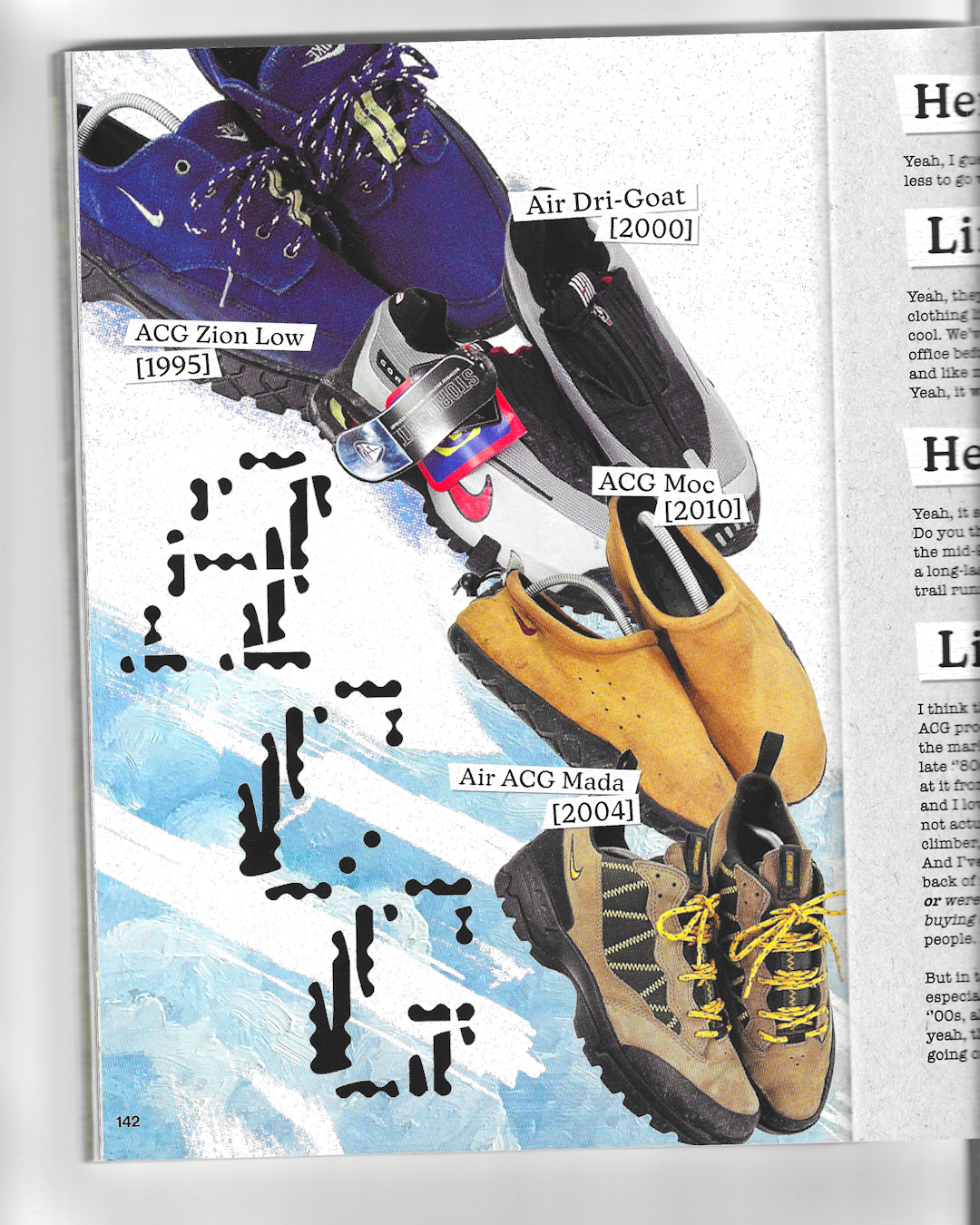
Linus (3): Favourite ACG pair? Fuck. I don't even know. There are so many…Pocket knife. The OG pocket knife. Yeah... The Harris Tweed ones. That is the best, that is my personal favourite of all time.
Then favourite Nike of all time? The Air Zoom Drive, from 1999, the yellow pair.
Henry: I saw those on the page today actually, and I saw in the caption, you said it was your favourite pair. Sticking to your guns then?
Linus: Yeah, that’s my favourite pair of all time.
Henry (2): Have you got both of those stashed?
Linus : I do, but you know what, the soles fell off the Harris Tweed Pocket Knife and I took them to Vibram. And I realised the other day, I don't think I ever even got them back. So I need to go back over to the store and see where my shoes are.
Henry: Haha, what do you think is the most innovative pair?
Linus (3): Yeah I would probably say the Tallac Light from ACG, there was so much technology and it had that weird kind of exoskeleton, and it was Peter Fogg designed.
Henry: Peter Fogg your favourite Nike designer?
Linus: Peter Fogg yeah, 100%.
Henry (2): Strangest pair? A pair that you've got, and you're like, what is this even for? Why does this exist?
Linus: Oh. I've had so many weird ones. I had some like javelin pairs that were designed for throwing the javelin, and they had this like Kevlar patch on the toe.
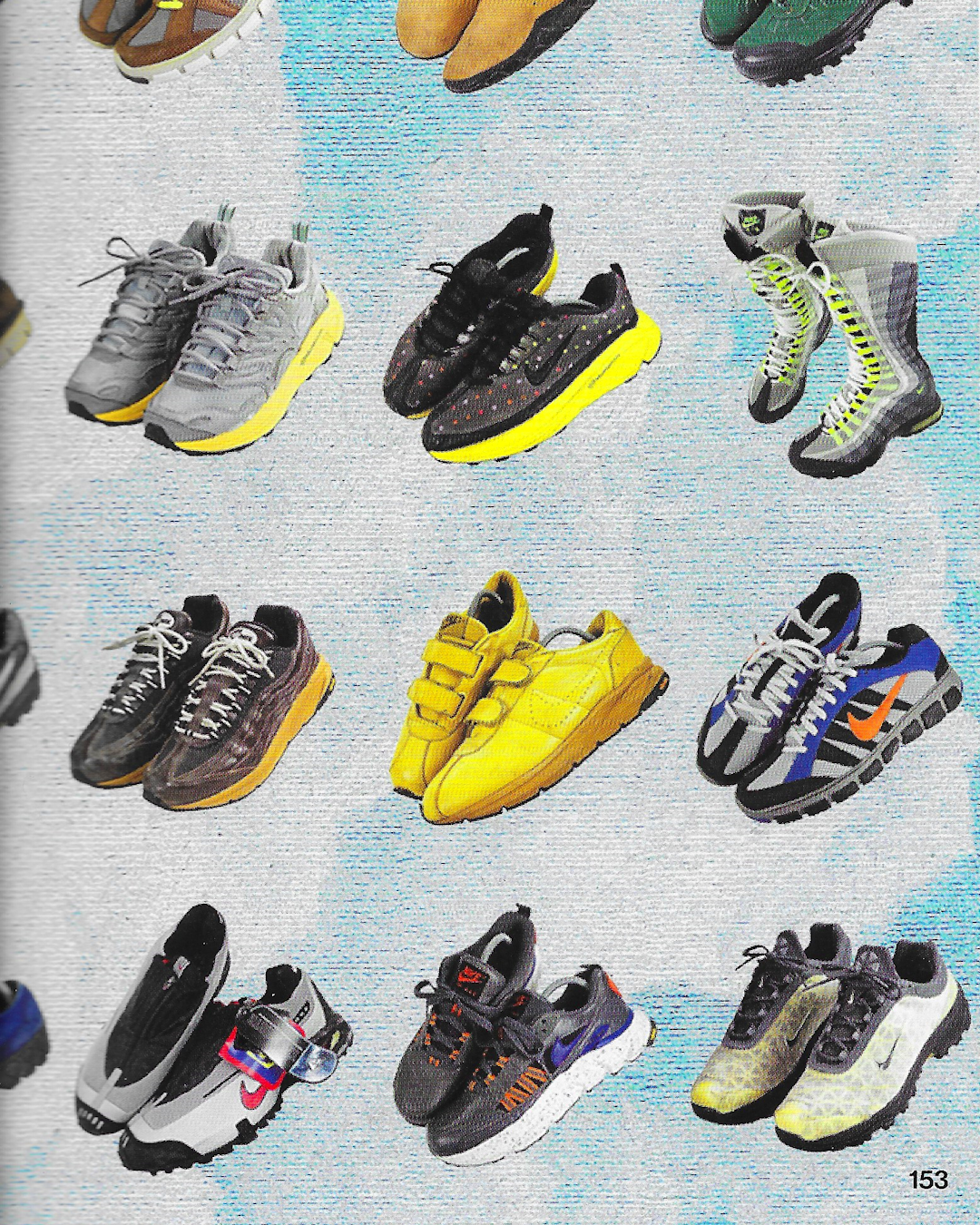
But aside from that, I had a pair of those like Kneehigh Air Max 95s, and I actually sold them to Bella Hadid, which is quite funny.
Henry: Haha, that’s mad. Do you also get people inquiring who work at brands to get their hands on stuff to inform design?
Linus: Yeah, A lot of the time. So we've actually, we've got a showroom at our office, just simply for that reason. We've worked with Dior, Supreme, Palace Casablanca, Givenchi... Yeah the list goes on. There are always people, in these brands, especially in footwear teams, who are really obsessed with interesting products. So yeah they come to the showroom quite often - whenever they're in London, we always invite 'em round.
Henry: You just mentioned Vibram there. How did that original partnership come about? Was that resoling thing your idea?
Linus: Yeah. So I was buying loads of shoes, and loads of them were falling apart. Some were coming and they were falling apart in the post. I would sell some, and they’d get returned. Eventually I tried to do resoling myself, but I didn't have the space, I didn’t have the equipment.
Henry: With what? With Vibram soles that you’d bought or?
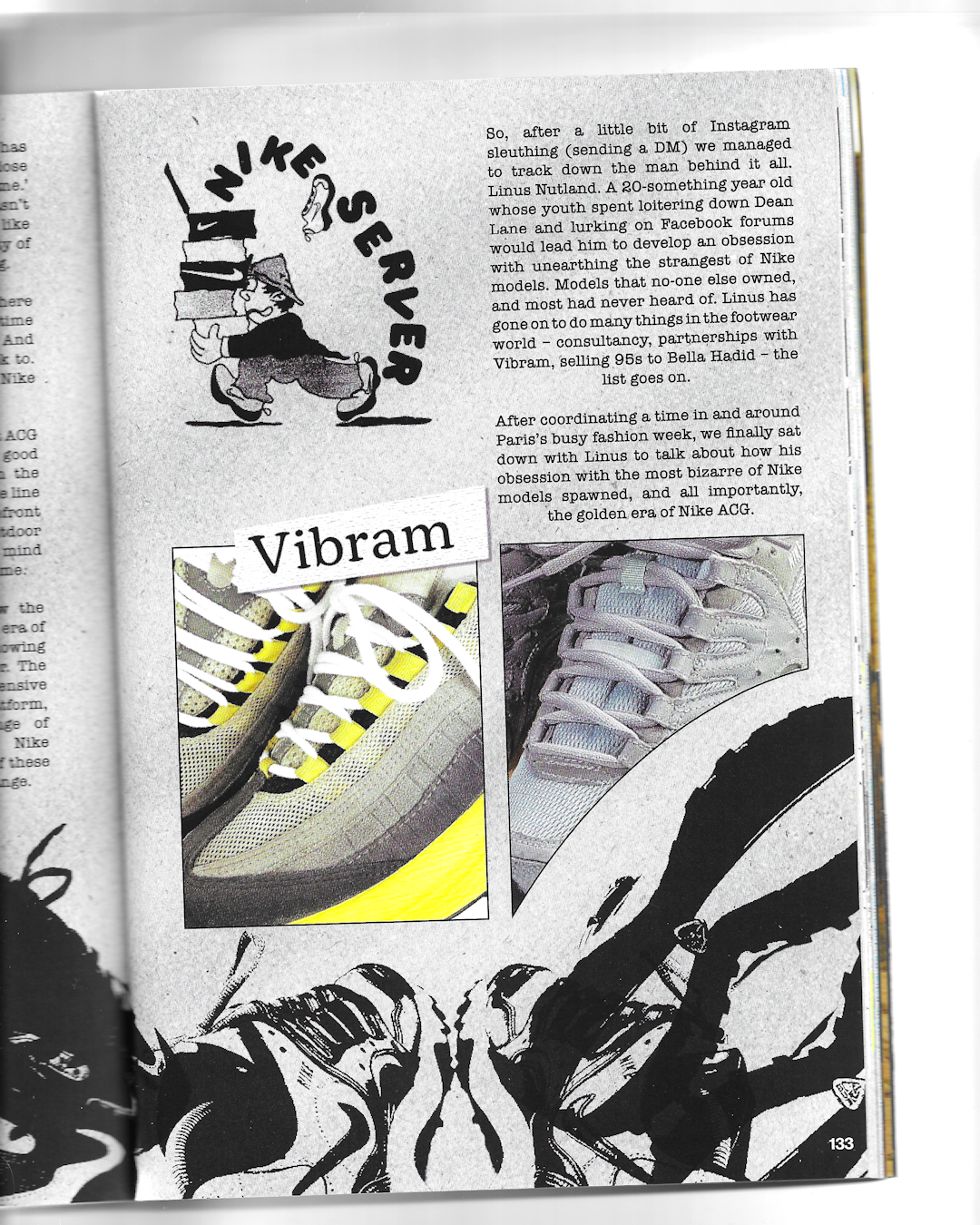
Linus: No, just kind of trying to reglue the broken soles back on, but then I heard about Vibram. I popped over to their store in London with like 20 pairs of shoes and was like ‘Can we do all of these?’ And they said yeah. So they did it. I shot the pairs, and put them for sale on Instagram.
Then someone from the headquarters in Milan reached out, and the partnership started there, really. They started sending me interesting soles from the factory that no one else could get, and yeah we started doing all these kind of workshops. We did the first one in Milan for fashion week 2021? Or 2022? I can’t remember. But basically we were just inviting people to bring their old shoes and we’d resole them. It was great. We did one in Paris a few months later, and then we did one in London and then we did one with END. as well, which was quite sick.
But yeah, since then I still go and get the odd pair resoled. I think that's really what put Nike Server on the map, it got a lot of press at the time, and yeah, we’re working on something at the moment with them and another retail partner. So hopefully that comes out soonish. But yeah, they’re really great people at Vibram.
Henry: Yeah, I remember it being a pretty big thing. I think the reason that it was so well received was because it was just so new and clever. I used to buy old ACG shoes and old Nikes from eBay, and was always so excited to get them. I’d be thinking, yeah the sole looks alright, they’ll probably be alright. And then the first time you take them out they start crumbling. It was the most soul-destroying experience. In both respects.
Linus (3): Yeah it’s a pain in the ass.
Henry: Another thing I wanted to talk about was how ACG seemed pretty popular among celebrities in the early nineties and two thousands. There’s a few images of celebrities from that time wearing obscure Nike ACG pairs - what celebrity do you think wore ACG the best?
Linus (3): Oh, that's a good question. I always find it quite funny when like the Spice Girls were wearing Humaras and stuff like that. Whenever I see Sporty Spice wearing like all these obscure Nikes and the Terra models, I think ‘that's quite sick.’
Henry: Yeah. Was she like buying those herself or was like somebody styling her?
Linus: She was probably getting styled, let's be honest.
Henry : Haha yeah, probably. Just to finish off, how many pairs of Nikes do you think you've currently got? And how many do you think you've had pass through your hands?
Linus: I counted my collection in my bedroom the other week before I had a little clear out, and it was like 101 pairs in total.
Henry: And this is just in your bedroom?
Linus: Yeah, thankfully, I've got a decent amount of storage in my bedroom, But yeah, not all of that is Nike. So I would say at the moment, I've probably got about 60 pairs of Nikes. Just in my bedroom. Then in the office, I've got maybe 30 pairs in the archive that I’m not selling and then I’ve got about 100 pairs in stock. And if I look on my website, I can see how many pairs I've sold... One minute...
It's about 700. But that's only from the last three years. So I don’t know. How many posts have I got on my Instagram? I can have a look now… There’s like 1,250 posts,
Henry: So that's 1,250 pairs, basically?
Linus: Well yeah, but sometimes there are multiple pairs in one post. So I don't know... I would say that I’ve had about 2000 pairs pass through my hands in the last yeah, seven years. Maybe more than that, I don’t know.
Henry: That's crazy. Imagine if you could see all those shoes in one room.
Linus: Yeah. it would probably smell a bit funky.
Henry (2): Haha, and finally, if you could bring back one characteristic of mid-90s to early 2000s, Nike design, what would you pick?
Linus: That's a good one. I think just some more like garish colorways.
Henry: Yeah, agreed. Alright, nice one Linus that’s all of my questions, thanks for chatting.
Linus: Nice one, Henry.
Henry: Take it easy. See you soon.